
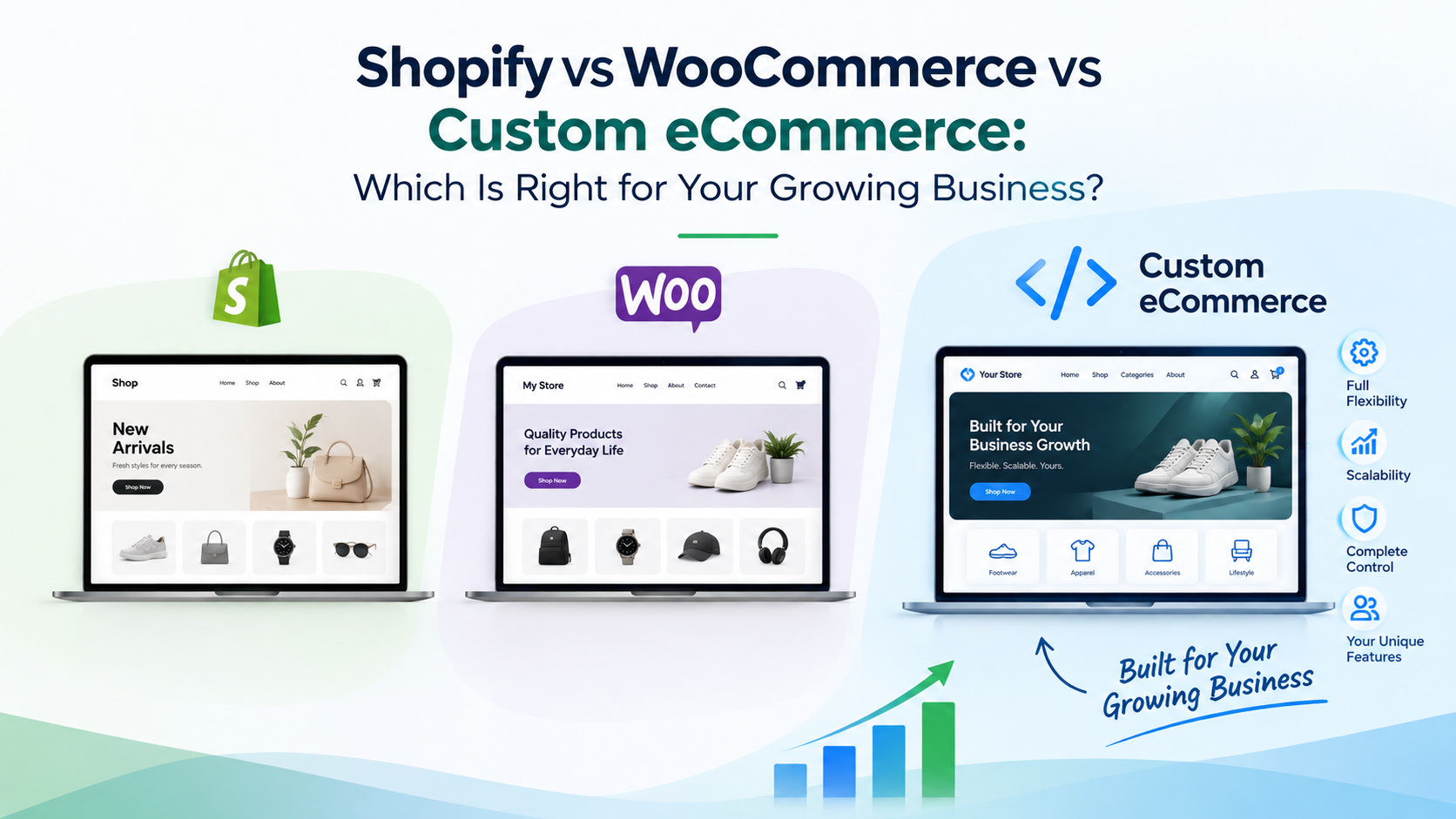
Every online retailer starts with a familiar goal: get products online quickly, connect a payment gateway, and start collecting orders. For that early stage, platforms like Shopify and WooCommerce are popular starting points.
However, once your sales volume crosses several hundred orders a day, the conversation changes drastically. You begin dealing with third-party transaction commissions, monthly SaaS bills for dozens of separate apps, plugin conflicts that break during checkout, and database lag that pushes page load times past three seconds.
At Technocraft Software Solutions, we regularly evaluate architectures for growing retail brands and digital distributors. The central question founders ask us is rarely "Which platform is popular?" It is: "At what point does staying on an off-the-shelf platform actually cost more than adopting a dedicated, custom eCommerce engine?"
Below is an honest, unfiltered comparison of Shopify, WooCommerce, and Custom Modular eCommerce across the metrics that actually matter: total cost of ownership, setup reality, checkout reliability, performance, and long-term control.
1. The Financial Reality: Platform Tax vs. Agency Setup Costs
A common misconception is that off-the-shelf platforms require zero upfront development investment. In reality, unless you are selling 5 basic products with a default template, most growing businesses hire specialized agencies or freelancers to configure themes, set up GST invoices, integrate Indian payment gateways, and configure shipping APIs.
The Real Math: A ₹1 Crore Annual Revenue Store (~₹8.5 Lakhs / Month)
Consider an Indian retail or D2C business processing around 1,000 to 1,500 orders per month:
- Shopify (Standard/Advanced):
- Agency Setup & Customization: ₹50,000 to ₹1,50,000 upfront for theme customization, app integration, and Indian checkout setup.
- Recurring Platform Costs: Base subscription (~₹2,500 to ₹8,000/mo) + 8 to 12 paid apps for reviews, upsells, GST invoices, and search (~₹15,000 to ₹25,000/mo) + 3rd-party payment gateway charges. Total recurring platform cost: ₹2.5 Lakhs to ₹4.5 Lakhs every single year.
- Shopify Plus Upgrade: If you need custom checkout workflows or tiered B2B wholesale pricing, Shopify Plus starts at a baseline of ~₹2 Lakhs/month (~₹24 Lakhs/year).
- WooCommerce:
- Agency Setup & Customization: ₹40,000 to ₹1,20,000 upfront.
- Recurring Overhead: Managed cloud hosting (₹2,500 to ₹6,000/mo) + paid plugin license renewals (₹30,000 to ₹60,000/yr) + recurring maintenance retainers to fix broken updates when WordPress and plugins conflict.
- Custom Modular Platform:
- One-Time Investment: Transparent initial setup, but running infrastructure costs drop to pure cloud hosting (typically ₹1,500 to ₹4,000/month on cloud infrastructure like Azure or AWS) with zero per-transaction commissions and zero monthly plugin fees. Over a 2-to-3 year period, the platform delivers significantly higher financial returns.
2. Architecture & Performance: Milliseconds Equals Revenue
Research across Indian eCommerce consumers shows that every 100ms of checkout latency directly increases drop-offs. In eCommerce, page speed is not just an SEO metric—it directly dictates your cart completion rate.
The WooCommerce Plugin Bloat
WooCommerce runs on WordPress, an architecture originally designed for blogging. To achieve essential retail features—abandoned cart recovery, tiered pricing, SEO schemas, pin-code delivery checks, and GST invoice generation—stores routinely run 25 to 40 plugins. Every page load executes hundreds of unindexed database queries, blocking the PHP thread and forcing Time to First Byte (TTFB) well past 1.5 seconds.
The Shopify Liquid & App Script Ceiling
Shopify runs on a multi-tenant cloud, which guarantees uptime. However, every third-party tracking pixel, review widget, and recommendation app injects heavy client-side JavaScript. Because store owners do not control the underlying server cache or database indexes, you cannot optimize server execution paths when your catalog grows past thousands of SKUs.
Enterprise-Grade Architecture: Why Speed Matters
In contrast, an enterprise-grade modular architecture separates high-frequency catalog reading from checkout write transactions. By compiling backend services natively and keeping product catalogs in in-memory distributed caches, category pages and filters load in under 80ms, delivering instant responsiveness even during high-traffic holiday sales.
3. The Checkout Nightmare: Payment Drops & Webhooks
For any serious retailer, the most critical step in the funnel is checkout. One of the single biggest operational headaches store owners face with plugins is the Payment Drop:
- A customer completes payment via UPI, net banking, or card on Razorpay.
- Their browser window accidentally closes before redirecting back to the store.
- The plugin fails to reconcile the asynchronous webhook event.
- Result: The customer’s bank account is debited, but no order is created in the admin system. Support is overwhelmed with frantic customer messages, and inventory numbers become inaccurate.
In our own Modular eCommerce Platform architecture, payment processing is treated as an idempotent, fault-tolerant background pipeline. Incoming webhooks are verified cryptographically, queued, and retried automatically. If a customer loses internet connection mid-payment, the backend matches the gateway transaction ID and confirms the order with zero manual intervention.
4. Comprehensive Comparison Table
Here is how the three approaches stack up across key business criteria:
| Feature / Factor | Shopify | WooCommerce | Custom Modular Platform |
|---|---|---|---|
| Time to Initial Launch | 1 to 2 Weeks (With Agency Setup) | 2 to 4 Weeks (With Agency Setup) | 1 to 2 Weeks (Pre-Engineered Foundation) |
| Recurring Platform & App Fees | High (Monthly sub + 10+ paid apps) | Moderate (Hosting + Plugin renewals) | Zero (Hosting only) |
| Checkout Customization | Locked (Requires Shopify Plus) | Open, but fragile with updates | 100% Granular Control |
| Page Speed & TTFB | Moderate (Capped by apps) | Often Slow (Heavy SQL overhead) | Sub-Second (Native Caching) |
| Custom Business Rules (B2B/Tiered) | Requires expensive add-ons | Plugin-dependent | Native Domain Logic |
| Logistics & Courier API Automation | Limited by app marketplace APIs | Subject to webhook timeouts | Direct API Integration (e.g. Shiprocket) |
5. What You Save: Time and Cost by the Numbers
Adopting our pre-engineered modular eCommerce engine isn't just about avoiding vendor lock-in—it delivers measurable operational and financial advantages:
Lower 3-Year TCO
Eliminate recurring 1%–2% platform transaction cuts and ₹20,000+/month app subscription stacks.
Time-to-Market
Launch a production-ready custom storefront in 1–2 weeks instead of waiting 3–6 months for scratch builds.
Faster Page Speed
Sub-second page and checkout load times that cut bounce rates and drastically reduce cart abandonment.
6. When Should You Choose Which?
Stay with Shopify if:
- You are validating a brand-new retail concept with fewer than 100 SKUs.
- Your annual revenue is under ₹15 Lakhs to ₹20 Lakhs, where platform percentage fees and app subscriptions are still manageable.
- You have zero access to technical support and need a quick off-the-shelf starter store.
Stay with WooCommerce if:
- You already run a content-heavy WordPress blog or publication and want to sell simple merchandise.
- You have a modest catalog and an in-house WordPress administrator who can test and maintain plugin updates.
Invest in a Custom Modular eCommerce Engine if:
- You are spending more than ₹20,000 to ₹30,000/month across SaaS subscriptions, transaction fees, and external add-ons.
- You need tailored checkout flows: Multi-step enterprise purchasing, tiered B2B wholesale pricing, GST-compliant auto-invoicing, or custom discount rules.
- You have experienced payment drop-offs or broken webhook syncs during sales events and marketing campaigns.
- You need unified warehouse and logistics automation: Direct two-way sync with courier partners (e.g., Shiprocket) and automated AWB generation without manual Excel spreadsheets.
- You want your eCommerce platform to scale smoothly without paying an escalating monthly platform tax as your order volume surges.